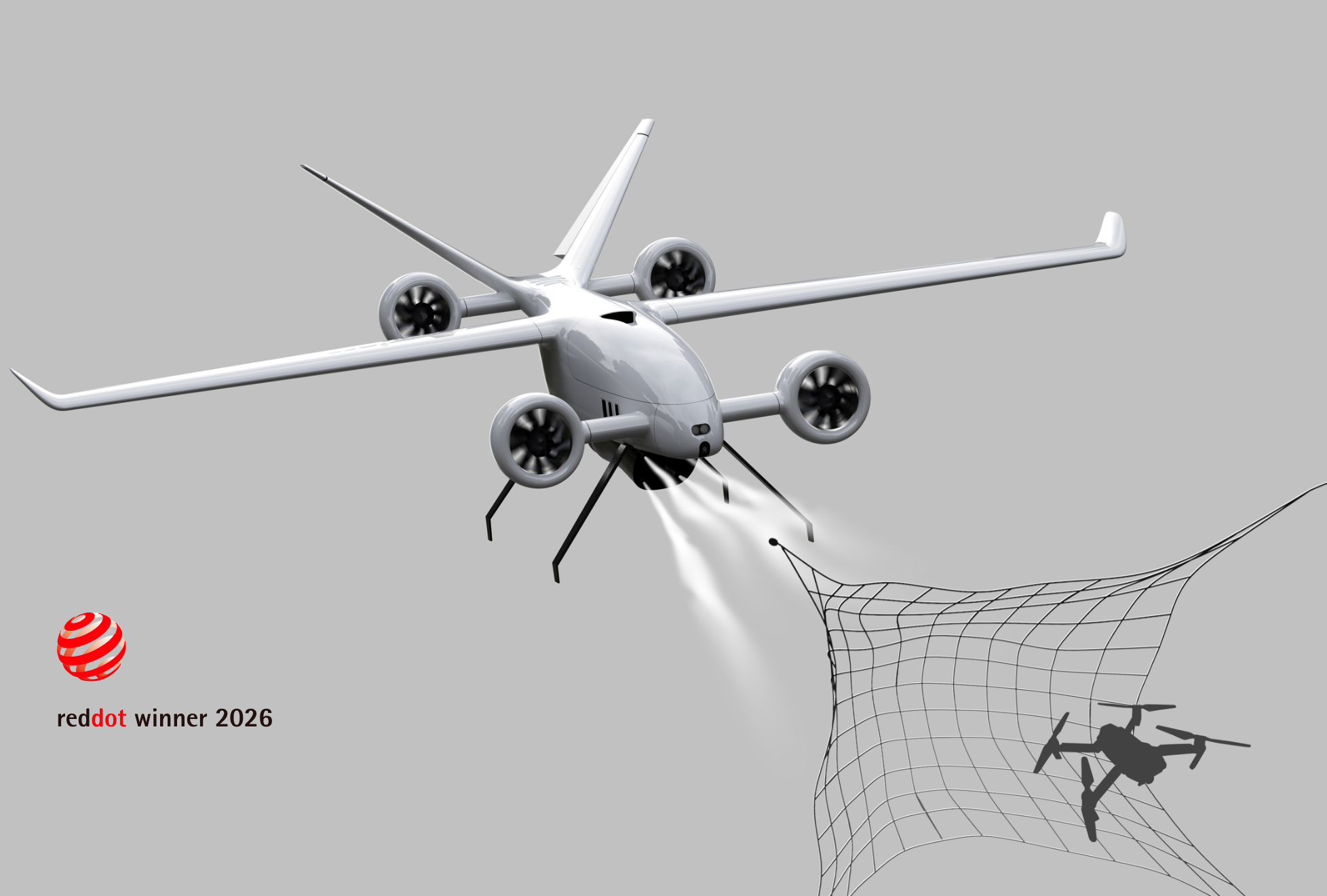
AB-U10, a 10 kg-class UAV, is the first counter-drone interceptor from a Korean company to receive the award
Following last year’s AB-U60, this year brings a double win with the AB-U10 and AB-M1300 — three Red Dot awards in two years
In-house design of battery packs and flight control software secures technological leadership; mass production system to be established within the year
[July 21, 2026] Airbility (co-CEOs Jinmo Lee and Taekyu Ryu), a deep-tech aviation and defense company, announced on the 21st that its 10 kg-class counter-drone (C-UAS) interceptor, the AB-U10, has received a Winner award in the Design Concept category of the globally renowned 2026 Red Dot Design Award.
This marks the first time a Korean company has been recognized at the award for a counter-drone interceptor. The AB-U10 is a dedicated interceptor that rapidly acquires and neutralizes hostile small unmanned aircraft. Its aerodynamic form is optimized for high-speed flight and aggressive maneuvering, and the aircraft was recognized for its design completeness as a weapon system on a stage otherwise dominated by surveillance and camera drones.
This design capability rests on the localization of core technologies. Airbility designs key components — including the battery pack and flight control software — in-house, securing technological leadership, while foundational technologies such as high-speed distributed electric propulsion build on domestic expertise accumulated by researchers formerly with the Agency for Defense Development (ADD). In contrast to a Korean drone industry that relies heavily on Chinese-made components, Airbility directly controls its critical components and diversifies the supply chain for commodity parts, reducing dependence on any single country.
Airbility also received a Winner award last year in the Design Concept category (transportation) for the AB-U60, a 60 kg-class unmanned aircraft. This year, the AB-U10 and the AB-M1300, an optionally piloted VTOL aircraft, were recognized side by side — bringing the company to three Red Dot awards over the past two years, in recognition of both its engineering capability and its design completeness.
Jaehyun Lee, Chief Product Officer at Airbility, said: “The shape of an aircraft is what remains after resolving, one by one, not only usability and operability but engineering conditions such as lift and drag, propulsion efficiency, mission equipment integration, and maintainability. Because a design award assesses not just that level of refinement but the engineering capability that produced the form, we find it meaningful that two aircraft with entirely different missions were recognized together in a single year.”
He added: “Our next task is to carry the completeness validated at the design stage through to the quality of the aircraft itself. We will complete the mass production system for the AB-U10 within the year and respond, in sequence, to domestic field demonstrations and overseas demand.”
Airbility has set U.S. defense startup Anduril as its benchmark for entering the global market. In a global C-UAS market led by Anduril — valued at approximately USD 61 billion — Airbility’s strategy is to combine export eligibility free from ITAR (International Traffic in Arms Regulations) constraints with eVTOL scalability, while offering price competitiveness at roughly one-tenth of Anduril’s. The company is also developing AIRLOCK, an integrated system that links the full sequence of detection, identification, tracking, engagement and assessment around the flight-proven AB-U60 mothership. By expanding its business model from individual product sales to integrated system sales, Airbility aims to establish itself as “Korea’s Anduril.”
Building on this recognition, Airbility plans to present its product lineup at major defense exhibitions in Korea and abroad, and to expand cooperation in earnest with prospective customers and strategic partners across the global defense market.
The achievement is drawing industry attention alongside the government’s recently announced policies to foster the defense and emerging-security industries. In June, the Ministry of SMEs and Startups convened a strategy meeting on fostering innovative companies in future security, announcing plans to cultivate a “Korean Palantir” built on private-sector innovation. Under the policy, the government designated drones and robotics, space and aviation as strategic emerging-security fields for concentrated support.
The Ministry of National Defense is likewise expanding opportunities to demonstrate drone and counter-drone technologies by opening military training ranges — including hosting the 2026 Korea Drone Offense-Defense Exercise — in order to accelerate the acquisition of advanced capabilities. The Korea AeroSpace Administration (KASA) has also unveiled plans to promote the commercialization of dual-use civil-military mobility through the development of AI-enabled unmanned aircraft and electric (hybrid) propulsion VTOL aircraft.